You Already Paid for the Cameras. Here’s What “Video Intelligence” Should Actually Do.
Most multi-site sites already have cameras, recorders, and storage bills. Video intelligence should mean trusted alerts on those feeds. Here’s the operational promise operators and partners should hold vendors to.
AwareCam team7 min read
You already paid for coverage
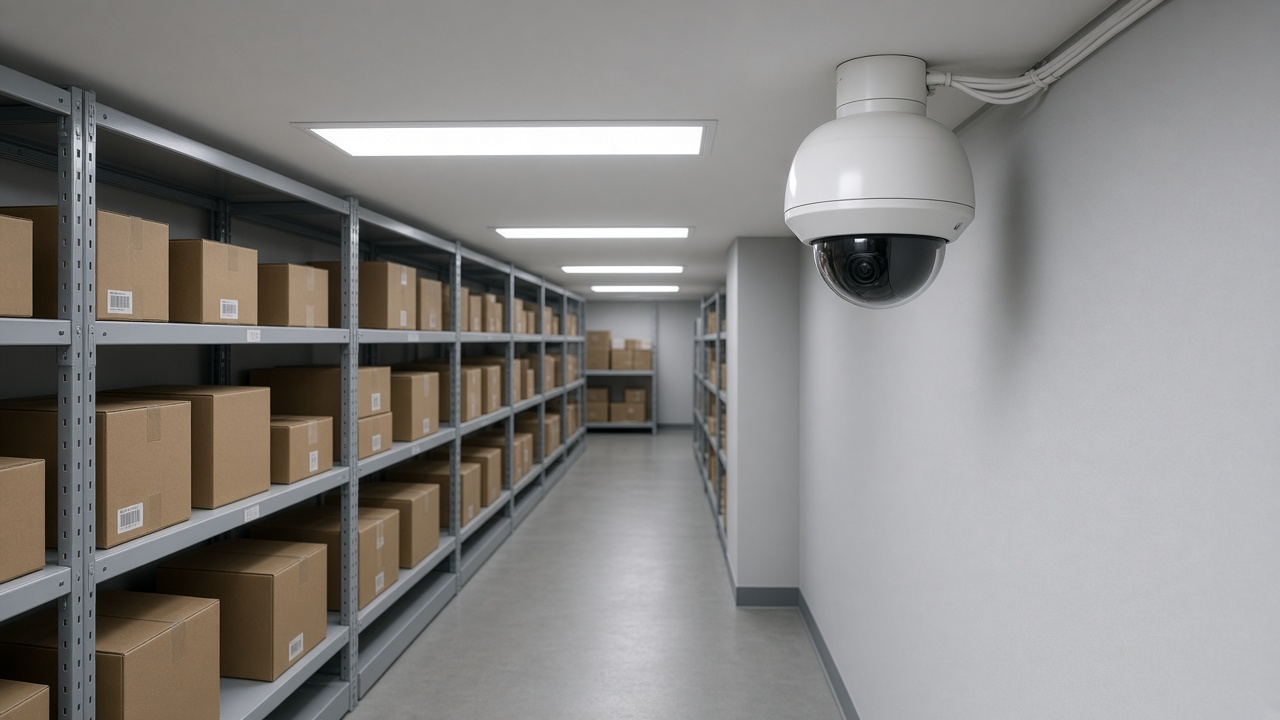
Walk any multi-site retail floor, warehouse, or campus facilities office and you will find the same pattern. Cameras are already mounted. Recorders are already running. Someone is already paying for storage, bandwidth, and the occasional hard-drive swap.
What is usually missing is a reliable way to turn those feeds into something a manager can act on.
Video intelligence is that: named events, the right person, enough context to act.
From a recording to a named event
Cameras solve a narrow problem well: they record what happened in a field of view. They do not, by themselves, decide what matters, who should be notified, or how fast a store or facilities lead needs to respond.
So teams compensate. They pull clips after an incident. They spot-check live views when staffing allows. They ask a guard company to watch a handful of sites.
Video intelligence, used carefully, means software that watches the same streams you already have and raises alerts only when defined events appear—after-hours entry in a closed zone, prolonged loitering at a high-loss bay, a dock door open outside schedule, a person where no one should be. Fewer ignored minutes. Fewer useless pings.
What “video intelligence” should actually do
Use the cameras you already own
Existing cameras are the default path. Add a camera only where coverage is missing.
Define events the way your sites actually work
Useful rules sound like: motion in the stockroom after lock time; person in the pharmacy aisle after the gate is down; vehicle lingering at the rear dock past schedule. Agents should follow your SOPs.
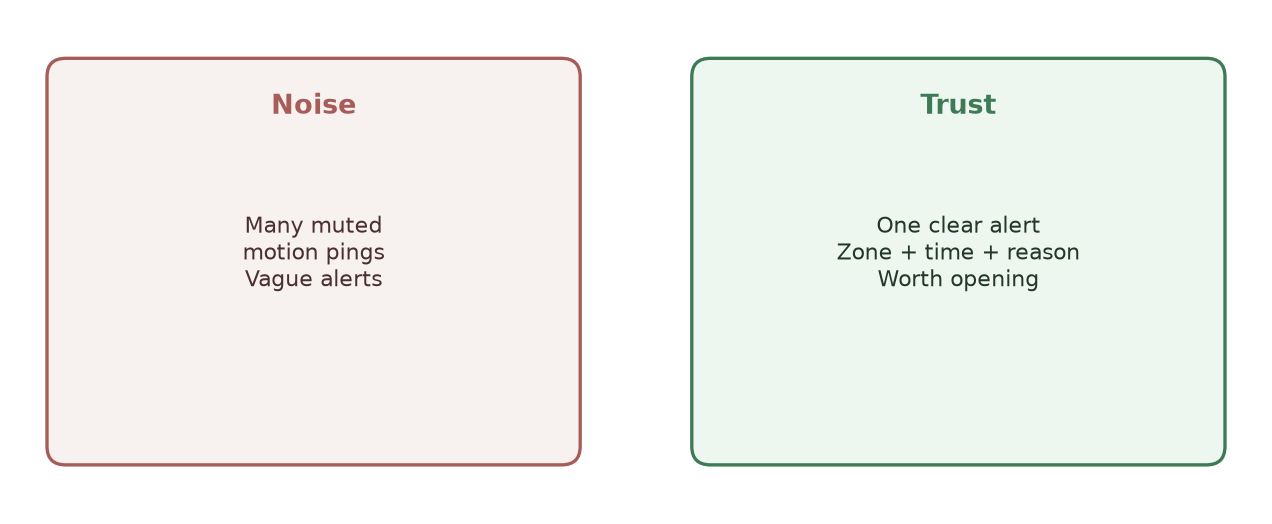
Produce alerts people trust
An alert that cannot be verified quickly becomes noise. Noise becomes muted notifications. Trust is the product.
Shorten time-to-awareness
Operators care whether the right person knew in time to intervene or secure a scene. Intelligence surfaces the right clip with the right context while response is still possible.
Fit multi-site reality
East Coast chains and multi-building facilities do not run one perfect store. They run uneven lighting, uneven camera ages, and uneven manager bandwidth. A system that only works in a pristine pilot aisle will not survive week three across twenty locations.
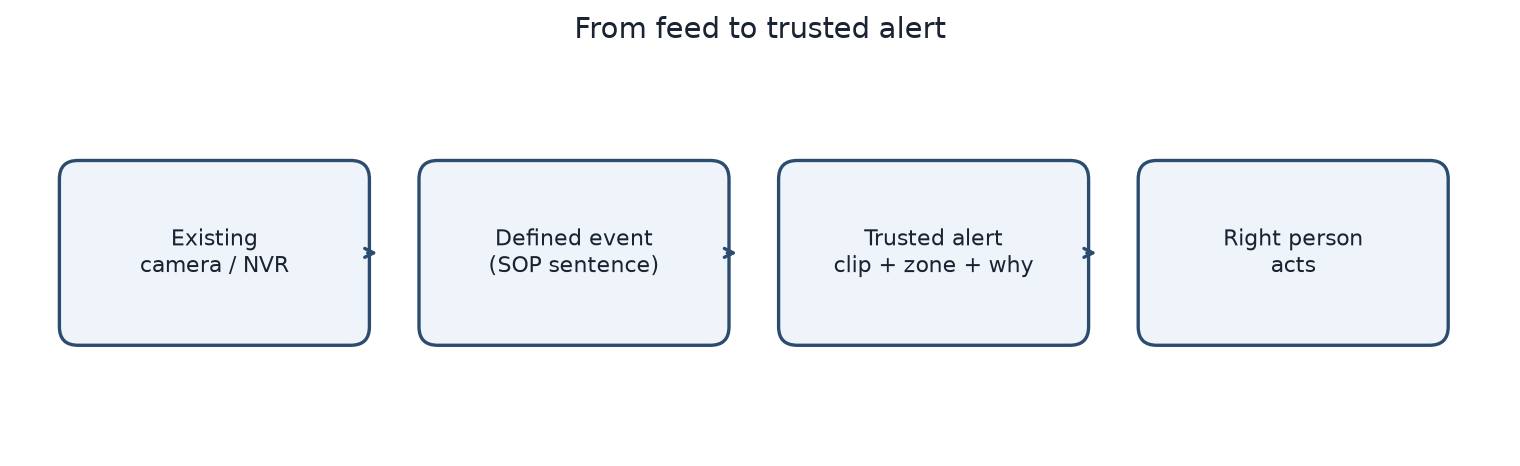
Video intelligence means using the cameras you already paid for to detect agreed operational events, notify the right people with enough context to act, and keep alert quality high enough that the system stays on.
How to evaluate a vendor
Use a simple review sequence. It works for direct buyers and for integrators vetting a partner platform.
- Inventory the cameras and NVRs you already have. Brand mix, resolution, retention, network path, who can access live vs. recorded.
- List three to five events that would change a shift if caught earlier. Be concrete. Write them as sentences a night manager would recognize.
- Ask how those events become alerts on your stack.
- Ask how false or low-value alerts are handled after week one, when novelty wears off.
- Ask who maps agents to your sites, and expect a scoped proposal after that review. Zones, schedules, and handoff are the work. No public price list. We scope after reviewing your cameras and sites.
Serious video intelligence on existing cameras is a project plus ongoing refinement. Expect setup and iteration measured in weeks — about 3–4 weeks is typical.
Coverage, speed, and alert trust
Look for a clear line of sight to three qualities:
- Coverage: Are the right zones watched for the right events when staff are thin?
- Speed: Do the right people learn sooner than they would from a morning clip review?
- Alert trust: Do managers still open the notification in month three?
A useful proposal speaks to those in plain language—your cameras, your sites, your event list.
Take this definition into the next meeting
Everything else—buzzwords, dashboard themes, market-size slides—is optional decoration.
If you run retail, facilities, or a security practice that already installs and supports cameras, start there. Review the stack you have. Name the events that matter. Then decide whether a partner can turn those feeds into agents.
Sources
- National Retail Federation, National Retail Security Survey 2023 (FY2022 shrink context for why retail invests in loss tools): https://nrf.com/research/national-retail-security-survey-2023
- National Retail Federation press release on The Impact of Retail Theft & Violence 2025 (retailer-reported incident trends; technology among layered responses): https://nrf.com/media-center/press-releases/new-study-finds-retailers-continue-to-contend-with-rising-levels-of-theft-and-violence
- The Monitoring Association, ANSI/TMA-AVS-01 Alarm Validation Scoring Standard (industry move toward validated, scored alarm information for response prioritization): https://tma.us/standards/tma-avs-01-alarm-validation-standard/
Operational claims about AwareCam deployment timing and agent design are company positioning, not third-party statistics.