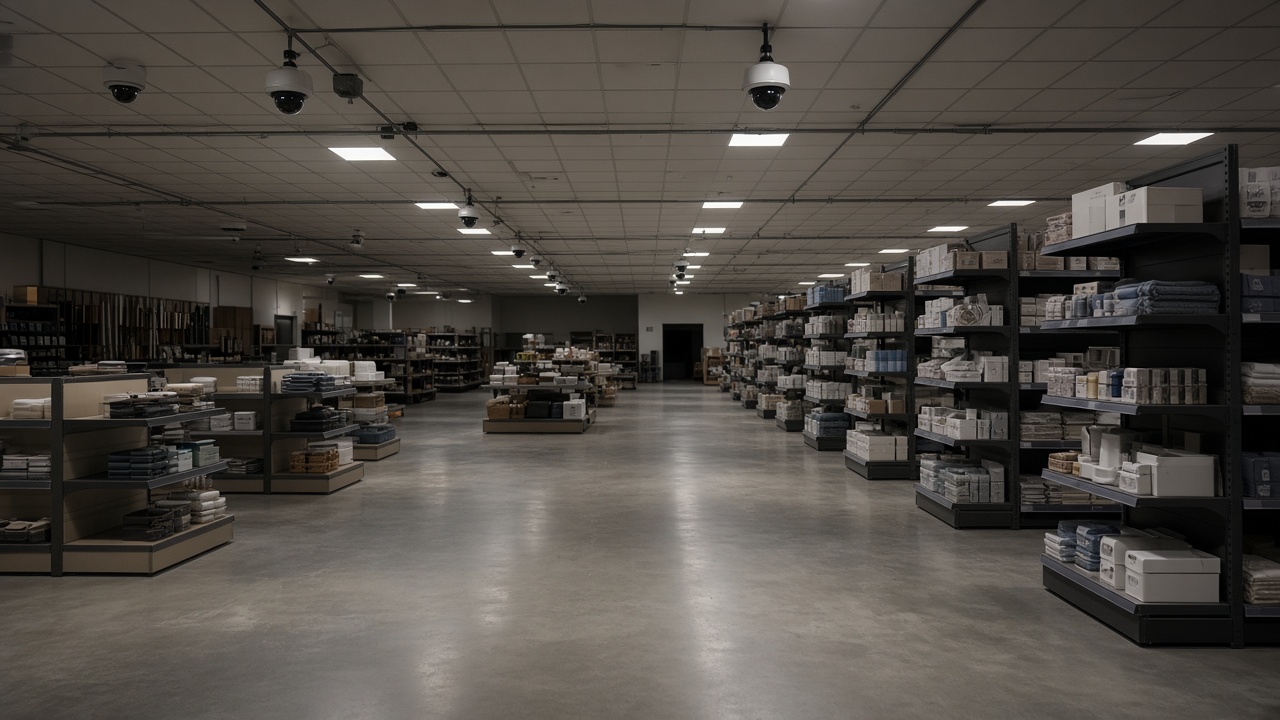
Retail Store Video Analytics That Operators Actually Use — Beyond the Dashboard Demo.
Retail operators have seen the clean-floor demo. Real chains have mixed cameras, uneven Wi-Fi, and managers who mute wolf-crying apps. Here’s what multi-site operators should demand: SOP events, trusted alerts, existing cameras, and outcomes that survive week three.
AwareCam team7 min read
What operators actually need from store video
Retail operators have seen the demo. A clean floor. Perfect lighting. A colorful map. A confident claim that “AI” will surface shrink, staffing, and customer experience in one pane of glass.
Then the software meets a real chain: mixed camera ages, uneven Wi-Fi in the stockroom, a closing checklist that differs by region, and a district manager who will not open another app that cries wolf.
Most multi-site retail teams already use video for investigations. Someone can find a clip after a known incident. That is necessary. It is not sufficient.
Operators need earlier awareness on a short list of events:
- After-hours presence in closed areas
- Exceptions at high-loss or high-risk zones during open hours
- Door, gate, or dock conditions that break procedure
- Situations where a store team should look now—not tomorrow during inventory explanations
The job is not “more data.” The job is trusted interruption: a notification worth opening because it is usually right, usually clear, and tied to a response path the store already understands.
Why dashboard demos mislead
Demos optimize for visual persuasion. Operations optimize for habit.
A dashboard can show traffic curves and dwell times that look executive-ready. Those views can help merchandising. They rarely change what a closing manager does at 9:40 p.m. when two associates are left and the back hallway should be empty.
If your evaluation criteria start with “How pretty is the UI?” you will buy a reporting layer. If they start with “Which alerts still get opened in month three across twenty stores?” you will buy something closer to operations.
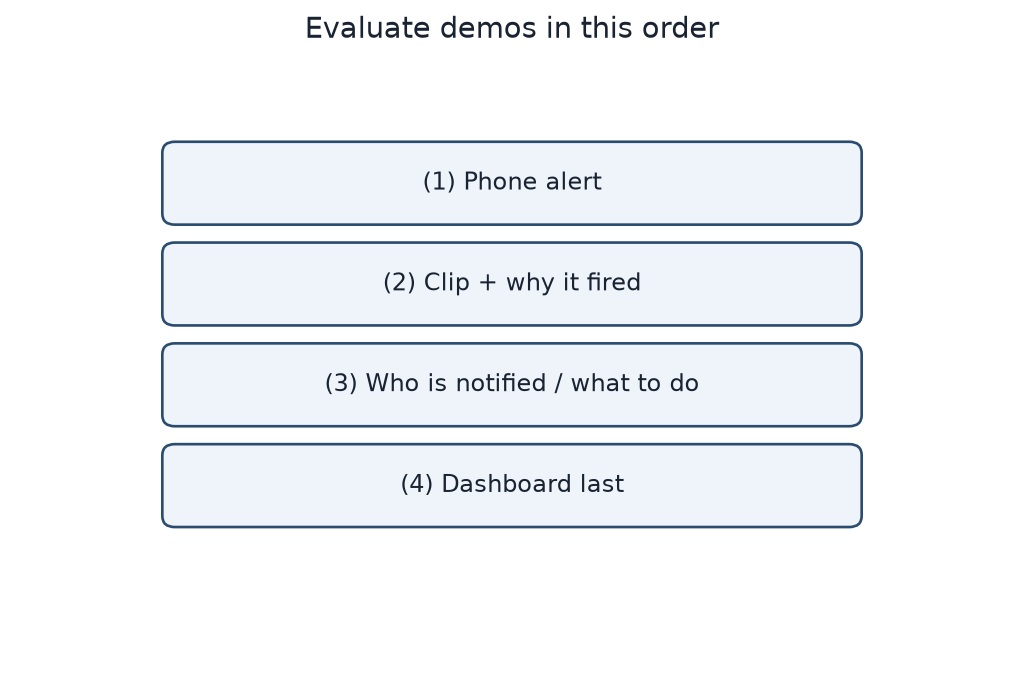
Reverse the demo order
Ask vendors to show:
- The phone alert first.
- The clip and the reason it fired.
- Who was notified and what they are expected to do.
- Only then the dashboard that executives might glance at monthly.
If the product cannot survive that order, it is not ready for store reality.
Existing cameras are the starting point
Multi-site retail did not under-invest in cameras. Many chains are camera-rich and attention-poor.
Rip-and-replace analytics projects compete with every other capital request in the company. They also create a false story: that intelligence requires new hardware first. Sometimes a dead zone truly needs another camera. Often the gap is that nobody is selectively watching the feeds you already paid to install and store.
A serious evaluation should inventory current cameras and NVRs before anyone proposes a wall of new domes. Platforms that treat your installed base as the default starting point respect how retail actually budgets and how fast a district wants proof.
Design events from your SOPs
Vendor menus love generic labels: intrusion, loitering, crowding, line queue. Those labels are starting points. They are not your store.
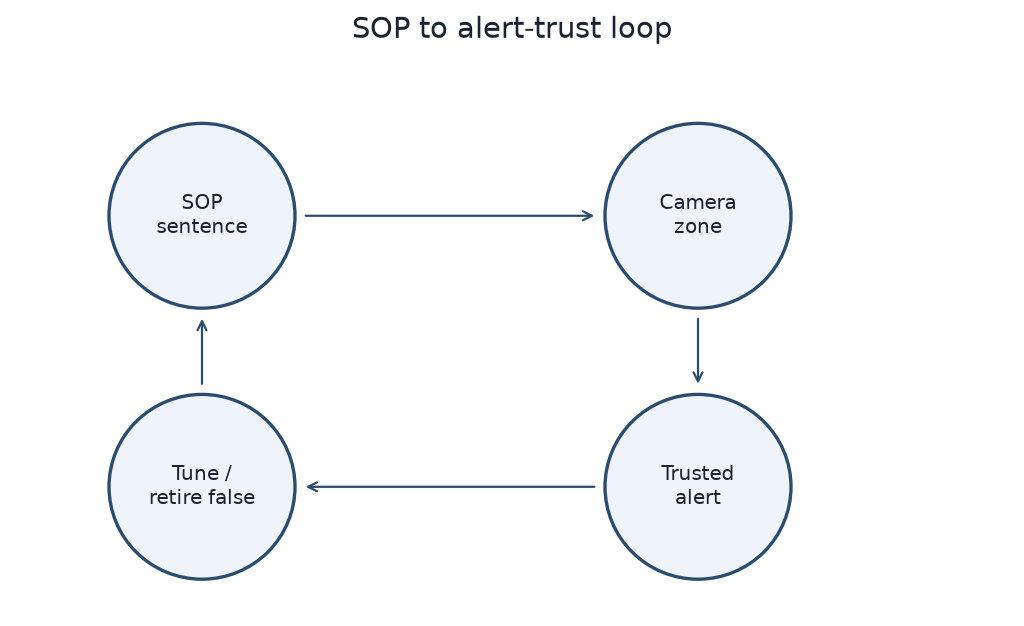
Translate your closing checklist and LP priorities into event sentences:
- “Person in stockroom after alarm set.”
- “Motion at emergency exit during closed hours.”
- “Prolonged presence at the high-shrink endcap after 8 p.m.”
- “Back door propped beyond policy.”
Then ask how the system encodes those sentences on your cameras, in your lighting, with your notification tree (store manager, LP, regional, guard partner).
If the vendor can only show a generic “loitering” tile from another industry’s pilot, you are still in brochure mode.
Alert trust is the conversion metric
Retail teams already ignore noisy systems: door chimes, motion emails, app badges. Video analytics join that pile unless quality is managed.
Treat alert trust as an explicit KPI for the pilot:
- Are alerts specific enough to act?
- Is clip context attached so the recipient is not guessing?
- How fast are obvious false alerts retired?
- Does open-rate (or response-rate) hold after novelty fades?
Industry conversations about retail theft and violence are real, and retailers continue to invest in layered security—including cameras and related tools. That does not mean every analytics package deserves a permanent home on a manager’s phone. Investment pressure makes it more important to separate useful detections from vanity metrics.
Keep industry statistics in perspective. National property-crime rates and retailer-reported theft trends are not the same dataset, and they do not move in lockstep. Your chain’s shrink drivers and store-level incident patterns are the brief that matters. Use national figures for context; use your event list for procurement.
Skip the demo that begins with a heatmap. Start with the notification you would still want at 11 p.m. on a Tuesday in a mid-volume store with a new manager.
Multi-site East Coast reality check
Operators running dense East Coast footprints deal with:
- Older urban spaces with awkward camera angles
- High associate turnover (institutional knowledge walks out)
- Regional differences in closing discipline
- LP teams stretched across too many doors
Video intelligence that only works in a flagship remodel will not travel. Ask explicitly how rules are templatized across sites, how exceptions are handled for odd layouts, and who owns tuning when store 17 starts false-alerting after a planogram change.
Consistency beats heroics. A district would rather have eight reliable after-hours event types everywhere than forty fragile detectors in one pilot store.
What “beyond the dashboard” looks like in a weekly ops rhythm
A usable system shows up in ordinary work:
- Night alerts that a manager can clear or escalate in under a minute
- Morning LP triage that starts from qualified events instead of raw motion search
- Regional reviews that compare event patterns across stores without requiring a data science internship
- Clear ownership: who changes a rule, who is notified, what “good” looks like
If the only person who understands the platform is the vendor engineer who installed it, you do not have an operator product yet.
How to buy without getting trapped
Use this procurement sequence:
- Camera and access review on a representative set of stores.
- Event workshop with store ops + LP (five to ten sentences max for phase one).
- Pilot with alert-trust metrics.
- Scoped proposal—after camera counts, sites, and the event list are understood, not from a public price list.
- Expansion criteria written before the pilot ends (what must be true to roll to the next district).
Stores are not identical. Phase one should name the events and the stores, then expand from written criteria.
Qualitative ROI that survives a CFO meeting
Lead the first conversation with a straight story:
- Coverage: High-risk hours and zones are watched when staffing is thin.
- Speed: The right people learn about defined events sooner than clip-pulling after the fact.
- Alert trust: Notifications remain part of the job, not muted noise.
If those improve, inventory loss conversations, safety response, and labor attention usually get clearer. If a vendor can only defend value with an unsourced percentage on a landing page, keep shopping.
Closing
Retail video analytics that operators actually use start with cameras already in the ceiling, events written in store language, and alerts that earn the right to interrupt a shift.
If the product cannot win there, it will not win your chain.
Sources
- National Retail Federation, The Impact of Retail Theft & Violence 2025 press release (retailer-reported increases in shoplifting incidents and violence during theft events; layered security investments including cameras): https://nrf.com/media-center/press-releases/new-study-finds-retailers-continue-to-contend-with-rising-levels-of-theft-and-violence
- National Retail Federation, National Retail Security Survey 2023: https://nrf.com/research/national-retail-security-survey-2023
- Bureau of Justice Statistics / FBI NIBRS Estimation Program, Crime Known to Law Enforcement, 2024 (national property-offense rates fell from 2023 to 2024—useful for separating national crime trends from retailer-reported theft experience): https://bjs.ojp.gov/document/ckle24.pdf
- FBI UCR Summary of Reported Crimes in the Nation, 2024 (shoplifting noted as the most common specified larceny-theft type in 2023 and 2024): https://cde.ucr.cjis.gov/LATEST/resources/reports/UCR%20Summary%20of%20Reported%20Crimes%20in%20the%20Nation%202024.pdf