Security With Cameras You Already Own: What Integrators Should Promise (and What to Avoid).
Integrators already won the hard part—site access, cable, and Friday-afternoon trust. Video intelligence should extend the cameras customers already own. Here’s what to promise, what to refuse, and how to keep alert trust alive after install.
AwareCam team7 min read
Why “existing cameras” is the channel-friendly path
Integrators already win the hard part of the relationship. You know the customer’s sites. You pulled the cable. You get the call when a recorder dies on a Friday afternoon.
That trust is the opening for video intelligence—if you sell it the way operators actually buy. The wrong pitch turns a good camera account into a failed analytics experiment. The right pitch extends the value of cameras the customer already owns and keeps you in the middle of the renewal conversation.
Most commercial accounts are not starting from zero. They have a mix of brands, ages, and recording setups. Asking them to rip and replace to unlock analytics creates three problems for you:
- It expands the project into construction, downtime, and capital approval cycles you may not control.
- It delays time-to-value, which is when customers decide whether the analytics story was real.
- It competes with your own prior work—you sold those cameras for a reason.
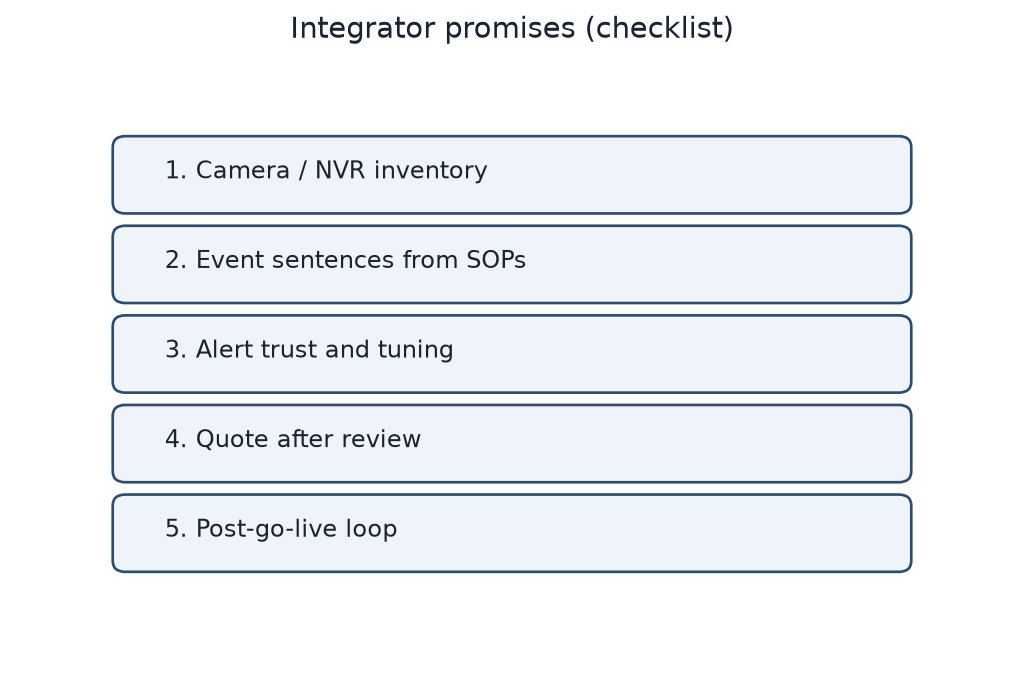
A cleaner channel story: keep the installed base, connect analytics or agents to the streams that already exist, and define events with the customer’s SOPs. New cameras still make sense where coverage is genuinely missing.
What integrators should promise
Promises should be operational and testable. Soft language loses to the next vendor’s slide deck. Concrete language wins renewals.
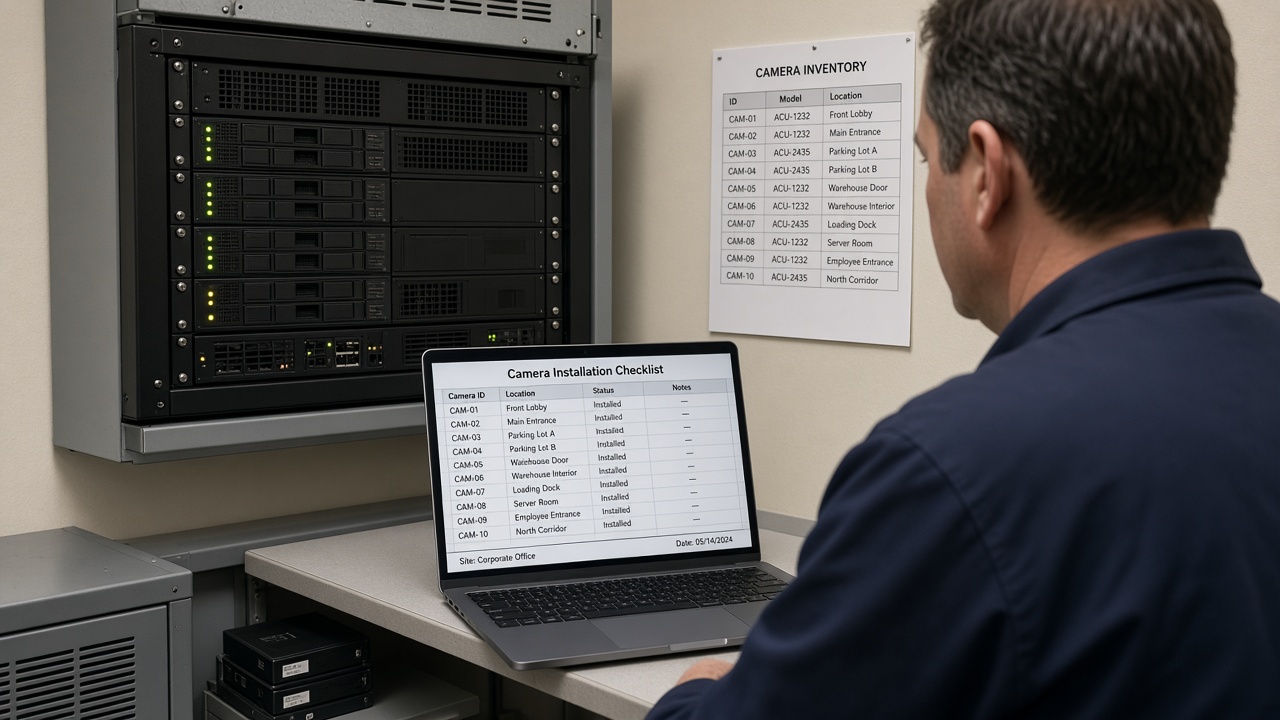
Promise 1: Start from the camera inventory
Lead with a review. Brands, NVR/VMS access, retention, network path, who has live vs. playback rights. Customers hear “we work with what you have.” That is different from “we prefer our preferred camera line.” Compatibility details get confirmed during that inventory—not assumed from a brochure.
Promise 2: Define events before features
Sit with the loss-prevention lead, facilities manager, or operations director and write five sentences:
- What should never happen after close?
- Which zones matter when staffing is thin?
- Which doors or docks create the most after-hours risk?
- What does a useful alert look like on a phone at 11 p.m.?
- Who is on-call for which sites?
Those sentences become the acceptance criteria. Features without event definitions become shelfware.
Promise 3: Optimize for alert trust, not alert volume
Channel reputation dies when a site mutes notifications in week two. Promise a tuning period. The goal is actionable detection. If a rule fires constantly with no operational meaning, it gets fixed or removed.
Industry standards around alarm validation exist for a reason: public safety and monitoring centers have spent years separating noise from verified human activity. Commercial customers feel the same fatigue inside WhatsApp groups and email. Position validation and context—clip, zone, time, why it fired—as part of the deliverable.
Promise 4: Scope after you see the setup
Camera count, site count, event list, and integration path change the work. Write a scoped proposal after that review: which streams, which events, who is notified, and what “done” means after setup. A typical setup runs in weeks. No public price list. We scope after reviewing your cameras and sites.
Promise 5: Stay in the loop after go-live
Analytics that are “installed and forgotten” drift. Lighting changes. Displays move. A seasonal layout breaks a zone. Promise a handoff that includes who adjusts rules, how false alerts are reported, and how multi-site rollouts stay consistent.
What integrators should avoid promising
Avoid: “This replaces your guards”
Sometimes analytics reduce the need for linear human coverage in specific zones or hours. Sometimes they make a guard company more effective by pointing humans at verified events. Do not sell elimination as the headline unless you have a scoped design that operations leadership has already accepted. Overselling replacement creates angry stakeholders and cancelled expansions.
Avoid: “Any camera, any scene, day one, zero tuning”
Existing cameras vary. Night IR, backlight at entrances, PTZ tours, and compressed streams all affect detection quality. Promise a professional setup path. Do not promise magic on a neglected 720p corner camera aimed at a skylight.
Avoid: “Our dashboard will transform merchandising, LP, facilities, and HR”
One platform rarely owns every analytics story well. Pick the operational jobs you will stand behind—after-hours intrusion-adjacent events, high-loss zone attention, dock/door exceptions, occupancy or presence where it matters—and keep merchandising heatmaps in their lane if you offer them at all.
Avoid: Unsourced percentage claims
“Reduce shrink by X%” without a named study, year, and methodology is a trap. Retail shrink and theft reporting is already contested enough at the industry level; NRF itself has moved away from treating a single shrink percentage as a sufficient industry benchmark. If you cannot cite it, do not say it. Sell coverage, speed, and alert trust instead.
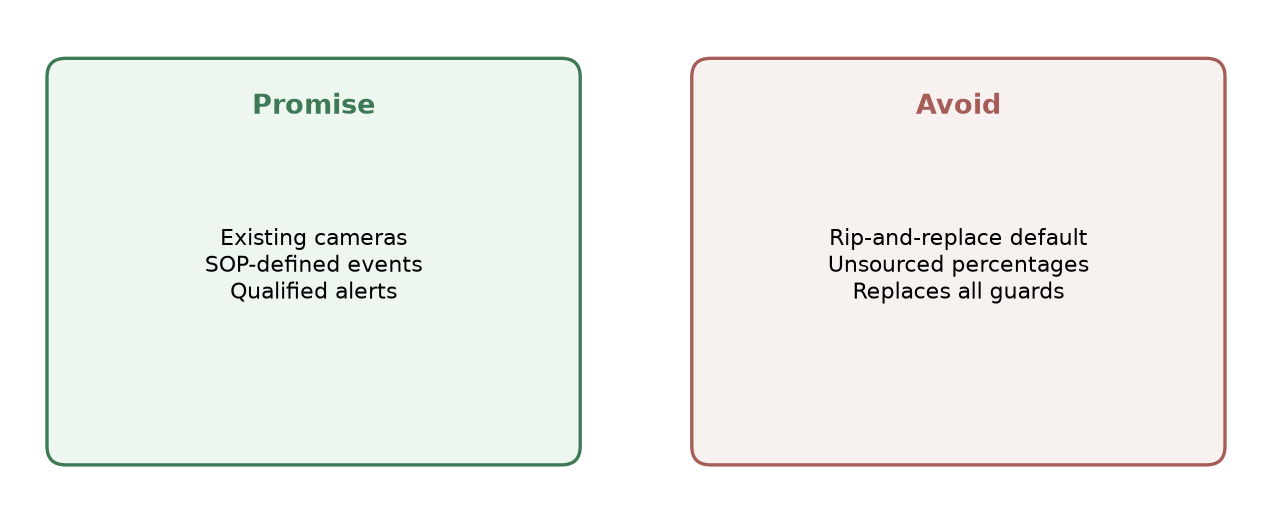
Your advantage is access and trust around cameras that already exist. Protect that advantage.
A reseller conversation script that stays honest
Use something close to this on a first call:
- “Show me the cameras you already trust for investigations.”
- “Tell me three events that would change a shift if you knew sooner.”
- “Who gets notified today, and what do they ignore?”
- “We will map agents to those events on your current stack where feasible.”
- “We scope after we review access, zones, and event design.”
That script keeps the call on the cameras, the events, and who acts on the alert.
Guard-camera operations: sharper dispatch, not louder
If you sell or run guard response tied to cameras, video intelligence should make dispatch sharper—not louder. The failure mode is flooding a mobile officer with low-value motion pops. The success mode is fewer, better-qualified events with clip context so the officer knows why they are rolling.
Align your promise with how monitoring centers already think about verification and scoring. Customers who have lived through false-alarm fatigue will hear “qualified alerts” as a serious sentence. They will hear “AI detects everything” as a future mute button.
Multi-site rollouts: sell consistency
Channel deals often start with a pilot site. That is fine. What you sell next is consistency: the same event language across locations, the same alert routing rules, the same tuning discipline. East Coast multi-site retail and multi-building facilities buyers care about whether site 14 behaves like site 2 when the night manager changes.
Document the pilot acceptance criteria up front. If the pilot only works because one technician babysat the rules, you do not have a productized service yet—you have a clever install. Fix that before you scale.
Bottom line for partners
- Promise inventory-first deployment.
- Promise event definitions tied to SOPs.
- Promise alert trust and post-go-live tuning.
- Promise a scoped proposal after camera and site review.
- Start from the cameras already installed, with a source and year on any percentage, and a scoped role next to the people already on site.
Do that, and video intelligence extends the security practice you already run.
Sources
- National Retail Federation blog on shrink vs. theft measurement complexity (why single shrink % claims are a weak sales crutch): https://nrf.com/blog/the-misperception-of-shrink-and-its-impact-on-organized-retail-crime
- Retail Dive reporting that NRF discontinued its annual industry shrink-percentage report after the FY2022 survey cycle: https://www.retaildive.com/news/no-nrf-annual-retail-shrink-report-2024/729009/
- The Monitoring Association, ANSI/TMA-AVS-01 Alarm Validation Scoring Standard: https://tma.us/standards/tma-avs-01-alarm-validation-standard/
AwareCam partner process and existing-camera positioning are company policy statements, not third-party market statistics.